The longevity of logic: Why thinking outlasts coding at scale
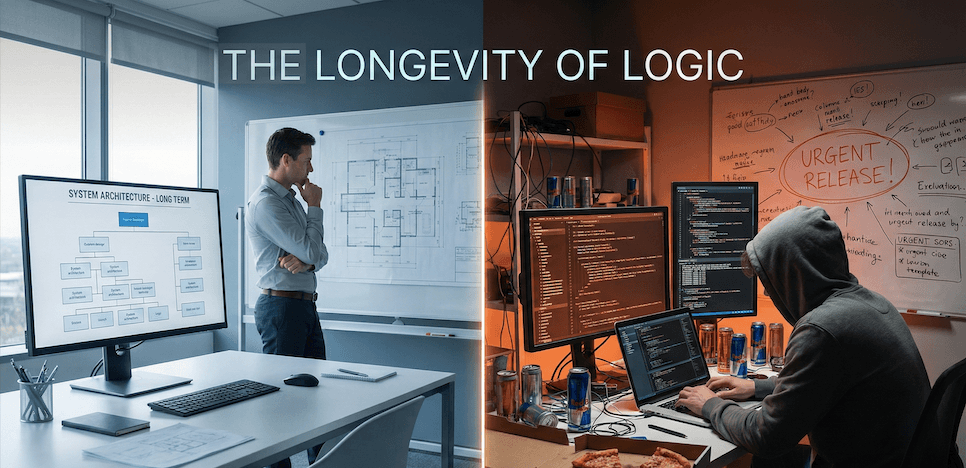
Discover why the most critical part of a Senior Data Scientist's workflow isn't writing code, but the 'structured pause'. Learn how to transition from reactive 'feature rushing' to building durable, impact-driven architecture that stands the test of time.
In my previous article, we explored how scale is a discipline. Today, I want to dive into the creation process. In my daily work, I have noticed a stark contrast in how new features are born. In a large corporation, we spend the majority of our time thinking and structuring, and only a small fraction of it actually developing. In the startup world, it is often the exact opposite. Here is why the architecture of thought is the only way to build solutions that actually endure.
1. The Power of the "Structured Pause"
In a startup, everything is urgent. You receive a task, and your immediate instinct is to open the IDE and start writing code. But urgency is often just a mask for a lack of direction. In a giant company, we don't start with code; we start with impact. We dedicate days to defining the flow, the data contracts, and the design documents. This isn't bureaucracy-it's *precision. When you think at scale, you realize that fixing a logical flaw in a design document costs nothing; fixing it after it has been deployed to millions of users is an operational and financial nightmare.
2. Designing for the decade, not the sprint
In small companies, features are usually built to solve a problem for today. At a global scale, we build for durability. A feature isn't successful just because it works for a week; it's successful if it can live, evolve, and remain maintainable for years without requiring a total rewrite. This long-term vision forces us to ask: How will this interact with systems that don't even exist yet? Startups often die not from a lack of features, but because their "quick fixes" turn into a tangled web of technical debt that makes future growth impossible.
3. Impact-driven design vs. Task execution
The biggest wrap for a developer or data scientist in a small team is becoming a "ticket executor". You receive a task, you close it, and you move to the next one without ever questioning the real value. In high-level teams, we are problema solvers, not just coders. We measure the "Latent Insight": How does this actually move the needle for the customer? If we cannot clearly define the success metric and the user journey before writing the first line of SQL of Python, the feature simply does not get built. In a startup, doing things that "sound useful" but don't drive real impact is the fastest way to burn through capital.
💡 Tips for small teams: building for longevity
To transition from "coding in the dark" to "architecting for scale", apply these principles:
- The 24-hour rule: Before coding any new feature, write a one-page document explaining why it needs to exists, how it will be measured, and what happens if it fails.
- Think in systems, not tickets: Every new feature should be a building block, not an isolated patch. Ask yourself: "Will this code still make sense two years from now?"
- Focus on the "Data Contract": Don't just build a feature; build a clean interface. Ensure that the way data flows in and out is well-structured so the system won't break when internal logic changes.