The manual they forgot to give us when started building at scale
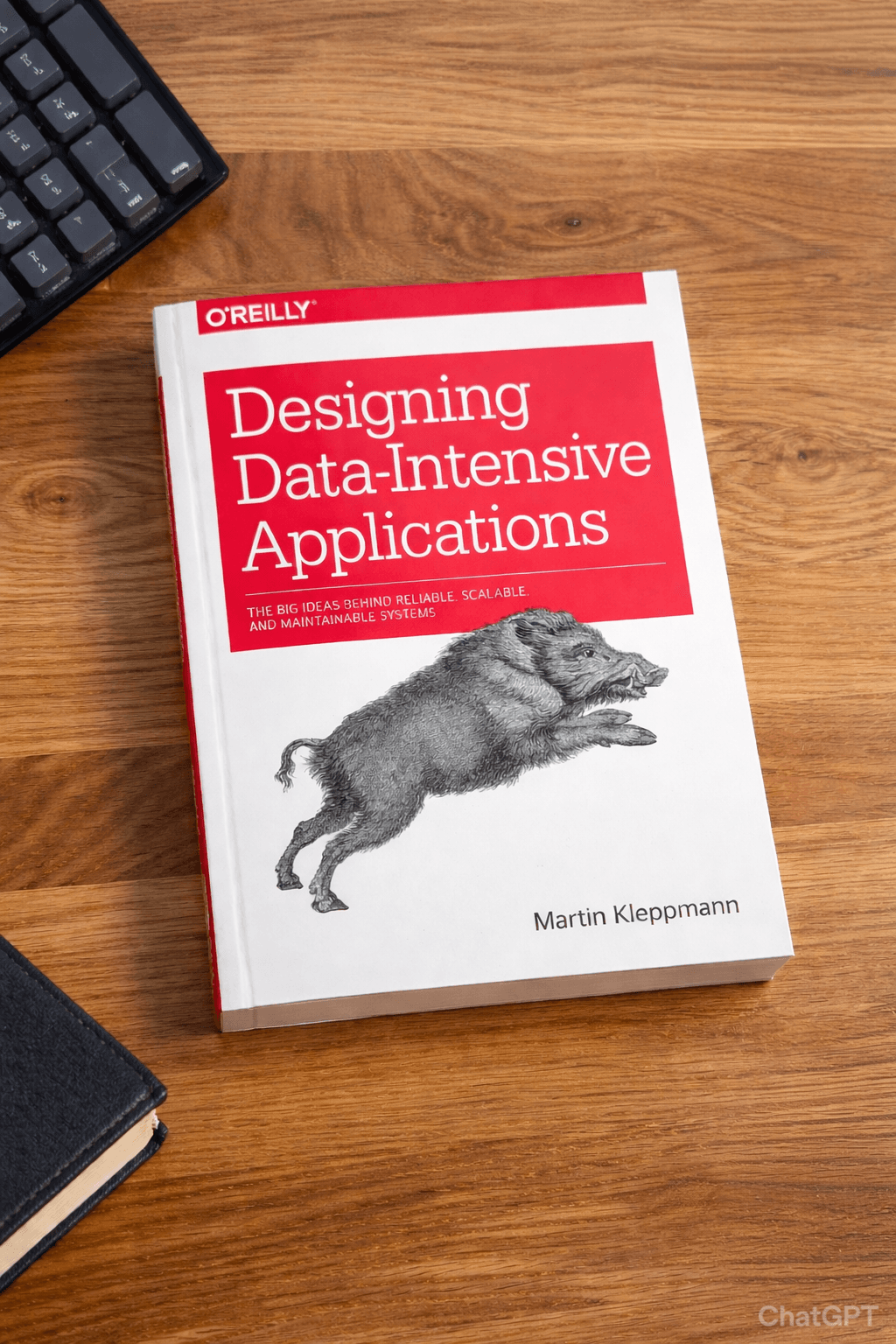
In a world obsessed with the newest data tools, Martin Kleppmann teaches the unchanging fundamentals of distributed systems. This book isn't just a technical guide; it's the litmus test I use to distinguish true senior engineers from the rest.
I have a confession to make about how I interview senior engineers and data scientist for roles at places like Amazon. When we get past the coding exercises and move into the system design interview-the part where most candidates stumble-I often use a simple mental heuristic to gauge their depth. I'm looking to see if their thinking has been shaped by Martin Kleppmann's Designing Data-Intensive Application. They don't need to mention the book by name. But I'm listening for the way they approach a problem. Do they inmediately jump to recommending a specific hyped-up tool ("Just use Kafka!"), or do they start by asking about the necessary trade-offs regarding consistency and availability? In the noisy world of data engineering and MLOps, where a new framework is launched every week promising to solve all our problems, Kleppmann's book is the ultimate anchor. It finds the signal within the noise. It doesn't teach you which tool to use; it teaches you how to think about the problems those tools claim to salve. It is, without hyperbole, the most important technical book I've read in the last decade. Here is why it remains the cornerstone of my engineering philosophy.
It’s a vaccine against hype
The defining characteristic of junior engineering teams is an obsession with tools. The defining characteristic of senior teams is an obsession with trade-offs.
Kleppmann dismantles the marketing fluff surrounding data technologies. He forces you to confront uncomfortable truths: there is no "magic scaling sauce." Every architectural decision is a compromise. You want lower latency? You might have to sacrifice some consistency. You want higher availability? Prepare for more complex failure modes.
Reading this book is like taking the red pill for software architecture. Once you understand concepts like "linearizability" or the innate problems with leaderless replication, you can no longer look at a vendor's sales pitch the same way. You start seeing the cracks in their promises before you even write a line of code.
The map of the territory
When moving from a startup environment to planetary-scale systems like those at Amazon, the sheer volume of technologies can be paralyzing. You have relational databases, NoSQL stores, stream processors, batch processors, message brokers, and fifty variants of each.
Before reading DDIA, my understanding of this landscape was fragmented. I knew how to use Redis or PostgreSQL, but I didn't fully grasp the deep connection between them.
Kleppmann provides the underlying map. He explains that a database, a cache, and a message queue aren't fundamentally different beasts—they are just different implementations of the same core idea: managing state over time. He breaks down complex systems into their atomic components—logs, indexes, replication protocols—and shows you how combining them differently results in the varied tools we use today.
This perspective is liberating. Instead of having to learn 100 different tools, you learn 10 fundamental concepts that apply to all of them.
Who should read this?
This is not light reading. You won't finish it in a weekend beach session. It’s dense, academic in its rigor, yet surprisingly readable.
If you are a data scientist who just wants to train a model in a notebook, this book is overkill. But if you are ambitious—if you want to understand how your models live in production, how the data pipelines that feed them actually work, and why things break at 3 a.m.—then this book is mandatory.
For anyone aspiring to a "Senior" or "Staff" title in Data or Software Engineering, Designing Data-Intensive Applications is not optional. It’s the baseline.