The Production Bar: Why Good AI Demos Are a Liability in 2026
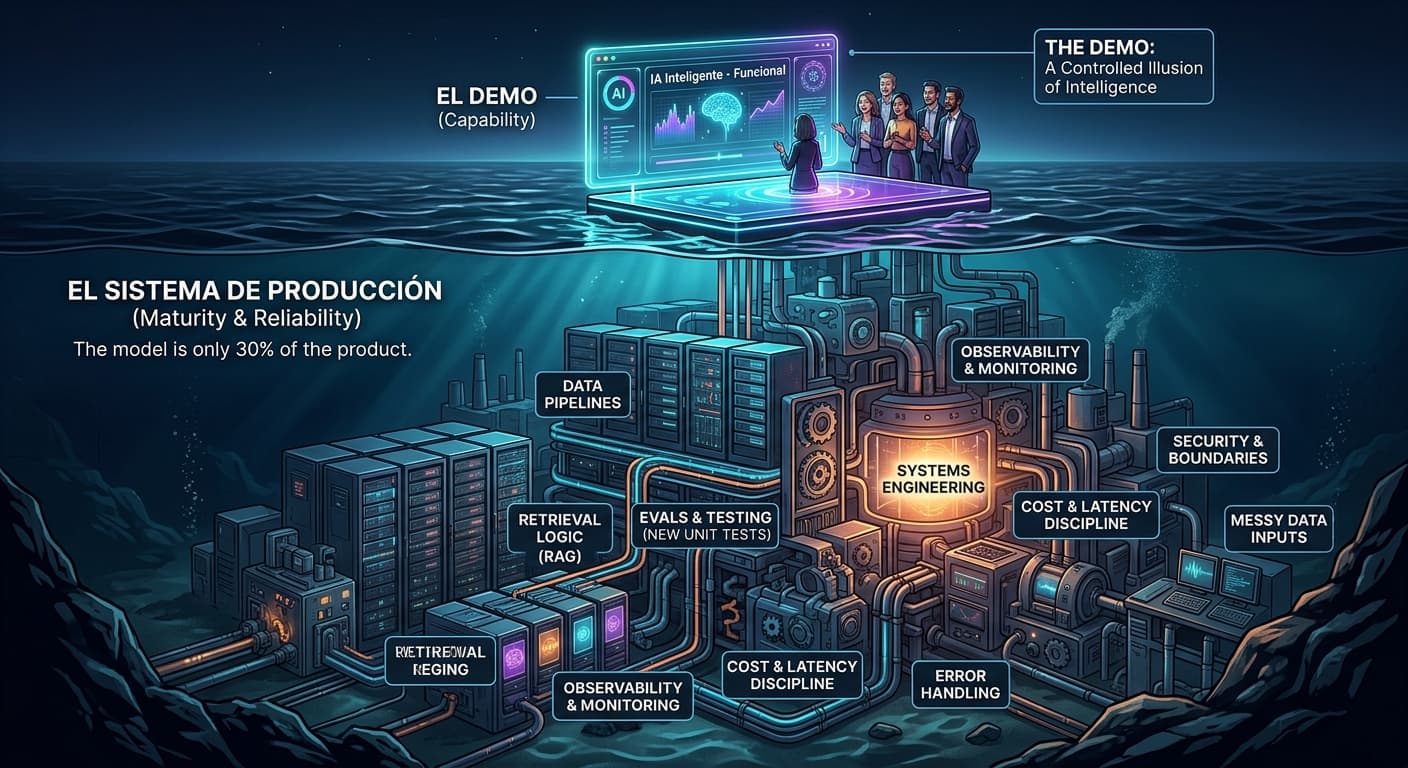
In 2026, building an impressive AI demo is no longer a signal of engineering maturity. The real bar is whether your system can survive production: messy data, hallucinations, latency pressure, token costs, security boundaries, and users who will inevitably break your assumptions.
In 2026, building an impressive AI demo is no longer impressive.
That might sound harsh, but it is the reality we are living in.
With the current GenAI stack, almost anyone can spin up a clean interface, connect an LLM API, add a vector database, write a polished prompt, and create something that looks intelligent in a controlled environment. The demo works. The client smiles. The investor leans forward. The team feels momentum.
But that is exactly where the risk begins.
Because the demo is not the product.
The demo is a controlled illusion of intelligence. Production is where that illusion gets audited by reality: messy data, ambiguous users, stale embeddings, broken pipelines, hallucinated answers, latency spikes, token costs, compliance reviews, security boundaries, and edge cases nobody bothered to write down.
A good demo can create excitement.
A weak production system creates liability.
And in 2026, the real bar for AI engineering is not whether you can a make model respond intelligently once. The real bar is whether you can build a system that remains realiable when the world stops being clean.
1. The demo trap: when capability looks like maturity
The biggest mistake I see in AI products today is confusing capability with maturity.
Capability is when your model gives a good answer in a curated scenario.
Maturity is when your system still behaves correctly when the input is incomplete, the data is outdated, the user is confused, the retrieval layer misses context, and the business cannot afford a wrong answer.
Most AI demos optimize for the happy path. Production is the graveyard of happy paths.
In a demo, nobody asks the question in the wrong language. Nobody uploads a corrupted file. Nobody tries prompt injection. Nobody asks for a refund policy that changed last week. Nobody test the system with 10,000 concurrent users.
Nobody asks who is responsible if the model gives legal, financial, or operational advice that turns out go be wrong.
That is why so many AI products feel magical in a pitch and fragile in the real world.
The model did not suddenly become worse.
The environment became real.
2. The model is only 30% of the product
In the GenAI era, many teams still behave as if the model is the product.
It is not.
The model is only one component inside a much larger operating system. Around it you need data pipelines, validation layers, retrieval logic, monitoring, evals, human review, rollback mechanisms, security controls, cost discipline, and ownership.
Without that, you do not have an AI product.
You have a probabilistic function wrapped in a nice UI.
This is where the difference between prompt engineering and AI engineering becomes obvious.
Prompt engineering can make a demo look smart.
Systems engineering makes a product survive.
A prompt can improve tone, structure, and reasoning behavior. But a prompt cannot fix stale data. It cannot enforce access control. It cannot guarantee schema consistency. It cannot monitor hallucination rate. It cannot define rollback strategy. It cannot tell finance why your cost per task doubled overnight.
That is the uncomfortable truth: the model is the visible part, but the system is where the real engineering lives.
3. Data quality is where intelligence starts breaking
Every serious AI team eventually learns the same painful lesson:
Prompt engineering cannot save bad data engineering.
If your customer records are inconsistent, your retrieval is outdated, your schemas change silently, or your features mean different things across systems, the model will not magically fix the problem. It will simply generate a confident answer from unstable inputs.
And that is dangerous.
A traditional software bug usually fails loudly. Something crashes. A test breaks. An API returns error.
A bad AI system often fails elegantly.
It gives a polished answer. It sounds reasonable. It maintains tone. It may even cite something that looks official. But underneath, it can be operating on old data, missing context, or a broken assumption.
That is why data contracts, freshness checks, lineage, schema validation, and monitoring are not enterprise bureaucracy. They are survival infrastructure.
If you cannot trust the data path, you cannot trust the intelligence built on top of it.
4. Evals are the new unit tests
In traditional software, no serious engineer ships critical code without tests.
In AI, too many teams still ship whit vibes.
They test five prompts. The answers look good. The demo works. The product goes live.
That is not evaluation.
That is optimism.
A real AI evaluation process should be treated like a core engineering asset. It should measure whether the system performs the actual task under realistic conditions, not whether the model sounds impressive in generic examples.
If you are building a customer support agent, your evals should test policy accuracy, escalation behavior, hallucinated promises, tone, refusal quality, and groundedness.
If you are building a data assistant, your evals should test SQL correctness, numerical accuracy, permission boundaries, source attribution, and safe handling of missing data.
If you are building an autonomous workflow agent, your evals should test tool usage, state management, side effects, approval boundaries, and recovery after failure.
The point is simple:
If your evals do not look like your product, they are not protecting your product.
They are protecting your confidence.
5. Observability is not a dashboard; it is an early-warning system
Most teams monitor infrastructure.
CPU. Memory. Error rates. Latency. Uptime.
That is necessary, but it is not enough.
An AI system can be technically alive and productively wrong. The API can return 200. The server can look healthy. The latency can be acceptable. And still, the model can be hallucinating policies, retrieving outdated documents, degrading for a specific customer segment, or burning five times more tokens than expected.
That is why production AI observability needs three layers.
System health: latency, uptime, retries, throughput, errors.
Model and data health: drift, retrieval misses, missing values, hallucination patterns, groundedness, prediction shifts.
Business health: task success, escalation rate, user trust, retention, conversion, and cost per successful outcome.
A dashboard that only tells you the service is alive is not enough.
The real question is whether the product is still useful.
Production does not reward teams with beautiful dashboards. It rewards teams that can detect failure early, recover quickly, and understand where reality changed.
6. Autonomy without boundaries is not intelligence
There is a dangerous fantasy in AI product design: the idea that more autonomy automatically means more value.
It does not.
Autonomy without boundaries is not intelligence. It is uncontrolled agency.
The moment your AI system can retrieve private data, call tools, modify settings, generate operational recommendations, execute code, approve workflows, or trigger payments, it becomes part of your company’s risk surface.
That means it needs engineering discipline.
Input validation. Output validation. Tool permissions. Least privilege. Audit logs. Human approval for sensitive actions. Clear fallback behavior. Incident response. Ownership.
Many teams resist this because it makes the product feel less magical.
But production systems are not supposed to feel magical.
They are supposed to be safe, legible, and dependable under pressure.
If your AI agent can create real-world consequences without approval boundaries, you did not build a smart product.
You built a liability with a clean interface.
7. Cost and latency are product requirements
One of the fastest ways to expose an immature AI product is to look at cost and latency.
A workflow that only works with the largest model, massive context windows, multiple retries, long tool chains, and unrestricted agent loops may look impressive in a demo. But at scale, it can destroy margins.
Users do not care that your system needed twelve internal calls to answer.
They care that it was slow.
Finance does not care that the output was impressive once.
They care that the unit economics are broken.
This is why cost and latency cannot be afterthoughts. They need to be part of the product specification from day one.
Model routing. Caching. Batching. Smaller models for simpler tasks. Prompt compression. Retrieval discipline. Timeout budgets. Token limits. Clear stopping conditions for agents.
If every request can become an expensive reasoning adventure, your AI product is not scalable.
It is a financial incident waiting to happen.
8. The real production bar
The real production bar for AI products in 2026 is not whether your model can answer a question.
The real bar is whether your team can answer these questions before launch:
Can we define exactly what task this system owns?
Do we know what happens when confidence is low?
Do we trust the data path end to end?
Do we have evals that reflect real user behavior?
Can we detect failure before customers complain?
Can we control cost and latency at scale?
Can we deploy gradually and roll back quickly?
Do we know who owns the system when it lies, slows down, or causes harm?
If the answer is no, the product is not ready.
It may be impressive.
It may close a pilot.
It may raise money.
It may even look like the future.
But it is not production-grade.
Pro-tips for raising the AI production bar
If you are building AI products today, these are the rigor mechanisms I would implement immediately.
Start with failure modes, not features. Before writing prompts, define how the system can break: wrong data, wrong retrieval, wrong reasoning, wrong action, wrong permission, wrong cost, wrong latency.
Treat evals like infrastructure. Your eval set should be versioned, reviewed, expanded, and connected to deployment decisions. If evals are optional, quality is optional.
Put cost and latency inside the product spec. Do not wait for scale to discover that your architecture is economically broken.
Design human review before you need it. Sensitive actions should have approval boundaries from day one. Adding governance after an incident is always more expensive.
Assign real ownership. Every production AI system needs a clear owner for quality, safety, cost, monitoring, and rollback. If nobody owns the system end to end, it is still a prototype.
Technical excellence in AI is not about making the model look smart in a demo.
It is about building the invisible machinery that makes intelligence reliable.
Data validation. Evals. Observability. Rollback. Security. Human review. Cost discipline. Ownership.
That is the real stack.
The model is visible.
The system is what matters.
And in production, the system is the only thing your users ever meet.
Previous
—
Next
—